Reebok Commercial
I worked on a Reebok commercial which showed me what a paid shoot can be like. I developed my skills such as being ready and available. When I did my first day I was a little bit rusty so on the first day I turned the HMI off and on by accident. This can cause a risk of blowing the bulb, fortunately as the bulb didn’t frost over, you could tell it was fine. There were a couple of us turning off the lights and some of the switches were reversed. It wasn’t clear which was which as we wanted to turn them off fully. We used five four thousand watt lights and they were all the same except from the switches on a few.
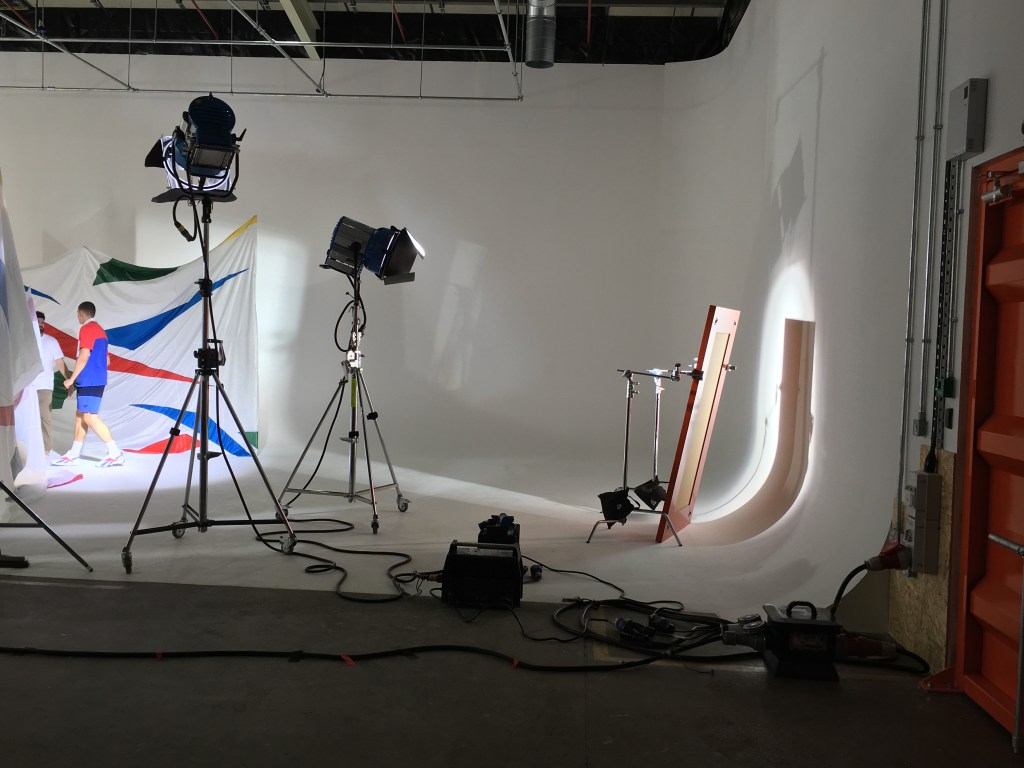
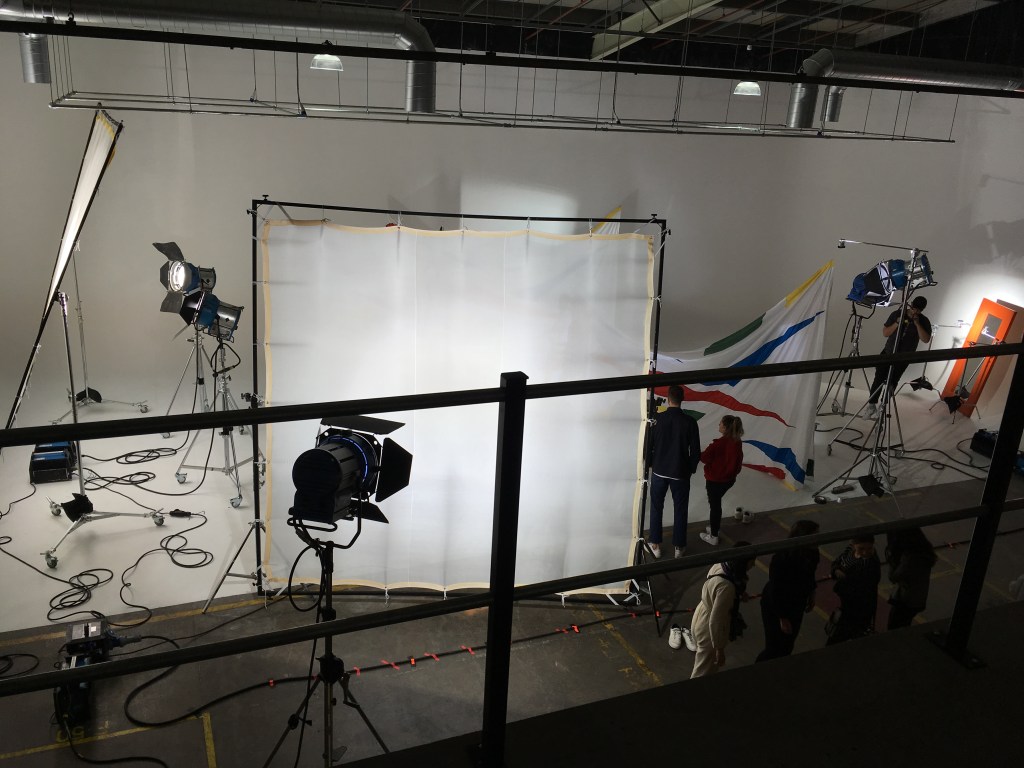
On the second day, I refused to make this mistake again, I turned off all the lights by myself and it saved the confusion. I improved my mistake and I have brought a new technique of keeping it one person turning off the lights. To be the most professional we got there first on set and waited, when they arrived we got straight into it and moved all the equipment out of the van into a secure location as quickly as possible. They wanted many different twelve foot silks putting up so we pre made them and stood them in a safe place. When we arrived, we noticed that there wasn’t an adapter for the power source, the Gaffer had to arrange one to come and this could have ruined any power for lights if it was not sorted. We set up all the stands to move them which made it a lot easier and then we set up all the four thousand watt lights on to one as it was clear from the DOP he had the intention to use it. The Gaffer stated “Charles was on time, professional and keen to get involved. He handled the equipment professionally and with extreme care. Working with high powered lamps and 20×20 frames can be difficult if not carful but he came in and set up everything correctly and safety. It wasn’t only just his care for setting up the equipment itself he also took great care into the cabling. Every cable was laid out correctly and neatly creating a safe working environment for all members of the crew. With only 3 lighting set ups throughout the day when he was needed he acted quickly and completed the tasks that needed to be done. Overall giving a good days graft.”. This is some of the best possible feedback I could get and I will continue to work with him.
There were a lot of problem’s as it was a new studio, we did not have any say in what equipment they want so it meant important things was missing in which we needed to use. Such things like Polyboard’s we have to root around the studio before we found one and we did not have one for the most of the shoot, fortunately I saw one when exploring the studio. We had to prop a mirror up to get a reflection in the background, we didn’t have the normal equipment we would use such as a K clamp. As a result, we used a Cardellini Clamp which is a very strong clamp used all the time in the industry to hold massive six thousand watt lights so you know it can hold a mirror. Because we were using so much power for three to four massive lights, we split it up on a splitter and turned all the lights down on the ballast, it wasn’t possible to smash them all on full power with the lights the DOP wanted to use. The studio could do with another electrical line and outputs so we run less risk of blowing the industry. I constantly checked the ballasts because we were using so much power they could overheat and I had to make sure they weren’t, there were also people treading on cables near the lights and we had to remind them as well as moving them as it seemed they didn’t get the message. This is very dangerous and we had to sort it otherwise it would have fallen on us.
Don’t Fear The Reaper Short Film

I helped out on a shoot at University as a Spark, there was a problem with a couple of Sparks doing one job with two people and because of that there was not enough Sparks. I had to check the ballasts throughout the day to make sure they were not overheating and this was not getting done beforehand. The Prospects standards states “ensure all lighting equipment is in working order and carry out tests”. We made sure that they were on separate lines but one of the lights was 2.5k watts so we really should check quite often. In NOS standard prepare battery lighting and systems, section P1 states “you should be able to calculate the current flow,” and there is an app called Watts which can be used to help you calculate it. I figured of eight all the cables as lets the current go smoothly through instead of it building up at one point if you wrap it up. I have learnt this technique from an old bit of work experience I had on a feature film called Banishment were other professional Sparks showed me that technique. We wanted two of the massive HMI’s outside in a similar position so we needed two close sources. We arranged one outside and one indoors then made sure there wasn’t loads of other equipment on the same line. They had diffusion on to match the softer sunlight and then we used a Kino light to bright up ones face and the others back which cast another nice soft light onto them. There were practical lamps above the heads which were coloured which the DOP wanted on so we arranged that with the technician then there was an orange gel on a three hundred watt Arri light for design which lit up the side wall as the characters walked in.
They wanted to cram a Kino light behind the bar, there wasn’t enough space, we moved the ladders which were in the way but the stand till didn’t quite fit. We got rid of the light and used it in the front of the bar when it wan’t in shot whilst making sure the continuity is still fine. This really helped with my development because I am thinking about were to put lights for design of a setting not just the characters. It keeps on reinforcing to me how important being safe as a Spark is as well as just cracking on with the job.
Pia Short Film
I became director of photography for the short film Pia. I wanted to create a shot list which wasn’t just full coverage and a couple other close-ups. When I got the script, I knew I would have the problem. I still created the shot list but didn’t do the last scene yet as I wanted to see if we could get rid of a scene considering the length of the project, the three different locations and the short window for light in the day with it being winter. Also, the director had wanted the script walking constantly, for such a dialogue heavy script I could not understand it. I managed to get it cut down slightly but then I found out I had done my shot list for the wrong script, I had been given the wrong script two times and I got help of the camera man to help simplify the shot list and pretty much wing it on the day.


When it got to the day, we filmed at the park first, straight away the director stated she wanted to have them sit on a random bench. I saw what the characters were wearing and I liked the colour of the brick wall and green bush, then the red rose matched nicely with her coat. It was quite a colourful film I just wish we didn’t have an overcast and we had a bit more time for the final shot as it was starting to really darken. I didn’t like the how gloomy the last shot is and I think it just needed a bit of orange light to brighten it up and give a bit of colour, the story was a heartwarming one so it could have been nice to. Although, we rushed through the last shot and made it a single shot so we saved a lot of time there wasn’t much else we could do on that day. If we changed days it could of helped, I asked to change days previously as it was on bonfire day but the producer couldn’t make it happen.


This project has helped me understand another role in lighting and a camera, how to put a scene together with colours and the camera. I learnt how to do the more technical paperwork such as shot lists and lighting plans and this will really help me when I do a script I really want to do. I have learnt how to work in a major of a crew and it took time to get used to it. At first, I was quite quiet and towards the end I a managed to be more in charge of the camera and lighting team and it worked really well. I had only done one or two simple lighting plans before. I knew I had to keep it pretty simple as the rest of the film was with natural light and bounce. Therefore, I added one strong HMI with diffusion and a half fresnel for the front of the light to imitate the sun. The fresnel was half on half off so when the characters were close it would be softer. A bit of bounce helped stand the character out from the background.


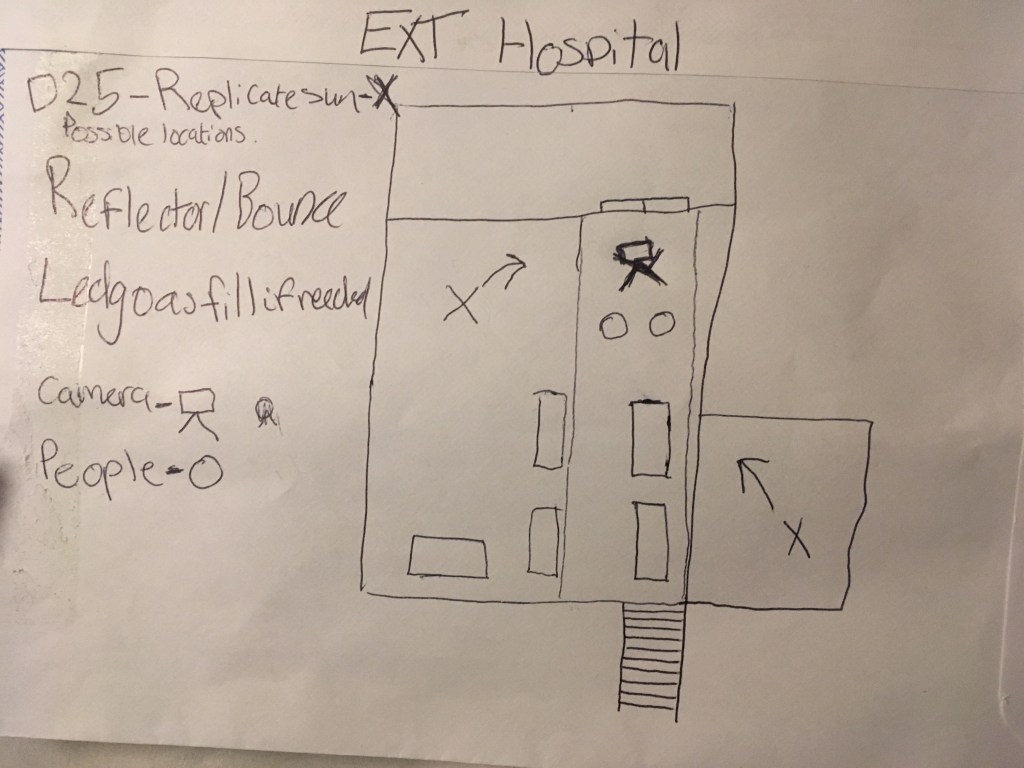
In P1 of Develop Lighting Designs for Live Productions, NOS standards states “analyse production requirements and any agreed lighting concepts to level of detail needed to develop designs”. I believe I definitely achieved this in the end, my communication was not the best at the start but when we got onto set I believe I got her vision and improved on it, she seemed happy at end and appraised our teams work on the film. I have learn’t a lot of different techniques on how I should light a scene in different locations with different conditions. Sometimes it is nice to use natural light and sometimes its nice to use vibrant colours but at the end of the day it depends entirely on what type of film you are making. You have to be very versatile and your problem solving has to be on point.
Evaluation
In this year, my professional practice has advanced my skills dramatically. It has taught me new pathways, transferable skills and invaluable experience. I have progressed from not knowing what I want to do, attempting different roles to becoming the main Gaffer. Finally, I attempted being DOP(Director of Photography), this showed me more of the camera side that I had seen before, especially since the start of University when that was my first choice. Also, it opened the avenue for problem solving in the camera side which I hadn’t thought about in a professional sense in years. On ScreenSkills it states “They read the screenplay and work closely with the Director to discuss the look and feel of a film.”. At first, my communication to the director wasn’t good enough and I had to improve that closer to the shoot, I looked at the scripts a number of times and created shot lists but I had been given the wrong script after asking for latest numerous times.
It went from the director and myself doing the shot list and storyboard separately which led to a bit of a separation and lack of communication. We both had our part to play in it and I believe we amended it when the shoot came and she was happy when she saw the result of our work. I believe we got some really nice shots. Both two shot of them on the bench were really nice as it was a bit unusual framing but it worked really wall with the wall, flower background and the park. Although, after looking at the footage, some of the shots at the start are a little shaky but we didn’t have access to a perfect stabiliser with the camera we could use. We had an easy rig which holds the camera on a wire and straps to a vest on your body, it is quite good but when you are moving with the camera it can come out too shaky. I quite like some of the shaky ones at the start but it changes style to smooth when they sit down and then changes back to shaky which felt strange in my head. We didn’t get a good enough bridging shot when the characters sat down and I wish we shot a much more stable shot without movement or on sticks with movement to make it extremely smooth. Blain Brown’s book states “Certain basic principles pertain to all types of visual design, whether in film, photography, painting, or drawing. These principles work interactively in various combinations to add depth, movement, and visual force to the elements of the frame. Unity, Balance, Visual Tension, Rhythm, Proportion, Contrast, Texture and Directionality.” I believe whilst being DOP I managed to get the proportion on the shots as we didn’t go for normal standard coverage and I wanted a couple unique two shots. The contrast, texture and colours were all thought about profusely and I think that they are the things I contributed most.
On ScreenSkills it states a requirement of the job is “DoPs and their camera crews arrive early to set up and rehearse”. We were the first ones there and went to check out the location, the Director had suddenly decided on a location and I needed to see it. We went there and saw a much better location right next the entrance, it also had a nice location right outside the entrance as well meaning we could bridge the two scenes together and save one location switch. This saved us a lot of time in the end and gave us extra time to have more takes on singular shots. We kept it pretty simple got coverage when they were sat down and went for a nice ending long shot. I really liked the long shot but no one was talking when they first walked in, if I were to do it again I would have liked to get them talking all the way down from when they walk up the stairs to when they leave.
The Reebok commercial was my first paid work, it is one of my most important experiences because it gave me the taste for paid work and the will to put one hundred percent in to become a Lighting Technician outside of University. It made me realise my level, that I am ready but that there were lots of areas for improvement as well. No one is perfect and it’s a horrible way to introduce yourself, acting like you know everything. This shoot has taught me never to go in acting like anything other than a student. You have to be confident in your skills but you can’t be deluded. I have learnt that networking is something I have to work on and I should build on the ones I already have. Working at the studio would be great and there are lots of opportunities to arise and it gives you the confidence to go out there knowing you can do the job. It is a fairly large studio and there are a lot of chance to experiment with a ginormous Infinity Wall, power and clients. There is chance to build sets and it is a massive building, with at four other studio rooms. It is an opportunity to get involved with serious clients and if I do a really good job every time one of the DOP’s/Gaffers may notice and offer work.
NOS states P5 in the standard in the Develop Lighting Designs for Live Productions as “present designs to relevant people, encouraging and integrating
constructive suggestions from them and negotiating when
appropriate”. We constructed the entire equipment agreed to be used by the DOP and offered advice on how we would hold the mirror and supply the power. We needed an adapter for the 63 amp plug, cardallini clamp to hold the mirror and pre made all the twelve foot frames with silks on and all the lights on the stands ready with cable standing by. We wanted to be as ready as possible and look as professional as possible and I believe we did a really good job there. At the end of the day, the owners of the studio seemed really happy and offered to pay our money instantly, they were pleased and some more work will come up in the future. To make sure, I will contact the Gaffer and to see if there is any more going. Blain Brown’s book says “ On every job there will be at least one HMI that will fail to function properly. Some rental-houses will provide a back-up head, ballast or both. Be sure to have a few extra header cables on hand. They are the second most common cause of malfunctions, the most common being the safety switch on the lens.”. You have to be ready for failure because with equipment like that something is bound to break.
The Synthesis Portfolio has showed me how far I have come as a Spark/Gaffer/DOP and that there a lot of opportunities coming up in which I can progress my career to a professional level. It isn’t going to happen instantly but I know I can do the hard work and I have the will. If I continue looking for work and then try and stay a little more busy at University just to keep my skills fresh. When I go onto a professional shoot like the Reebok commercial, I don’t make a mistake on the first day as I am rusty because sometimes one serious mistake can ruin your career as a Spark. Everyone makes mistakes but you have to be aware of any serious error and look at it almost like a law. Damaging equipment, constantly checking equipment, keeping team work and communication at its best are always a priorities. Sometimes, you can have moments were teams and DOP’s would push the equipment too far and risk endangerment, for instance people were treading on our cables at the studio. That could have blown the entire circuit so we had to constantly remind them to not stand on them. We moved it and taped them down and still they stood right next to it. Sometimes it is out of your hand but you would take the wrap because you should be aware of your equipment. It is still my responsibility and this has helped me because you have to be constantly checking any equipment. It could be overheating or it could be in dangerous position and I have to manage that even as a Spark. Finally, I believe this portfolio has helped me because I can put together my knowledge of taxes and business plan with my practical development and it has made me a much more professional Spark.
 Synthesis Portfolio